
How to Perform a Complete SEO Competitor Analysis: A Step-by-Step Guide for Businesses
Introduction
If you want to outrank competitors, attract more local customers, and build an SEO strategy that drives measurable growth, competitor analysis is non‑negotiable. Every search result you want to claim is already contested by rivals who understand parts of SEO — content, backlinks, technical optimisation, or local signals. A full SEO competitor analysis reveals what’s working for them, where gaps exist, and which tactics you should prioritise to win.
In this guide you will learn how to identify and prioritise competitors, audit their on‑page and technical SEO, analyse content and backlink profiles, benchmark local SEO performance, and convert insights into an actionable SEO strategy. Practical checklists, tools, and examples are included so you can run a professional standard analysis whether you’re an in‑house marketer or hiring an SEO agency in Edinburgh. By the end you’ll know exactly what to measure, how to interpret results, and which opportunities will move the needle fastest for your business. Get ready to turn competitor research into a competitive advantage.
Why SEO Competitor Analysis Matters
– Reveals where competitors are vulnerable and where they dominate.
- Helps prioritise high‑impact SEO tasks (content topics, technical fixes, link targets).
- Reduces wasted effort by showing proven tactics in your niche or locality.
- Strengthens local SEO by exposing citation gaps, review strategies, and Google Business Profile (GBP) tactics.
- Informs realistic KPI setting and resource allocation for your SEO strategy.
- Direct competitors: Businesses offering the same products or services in the same geography and price bracket.
- Indirect competitors: Companies that solve the same customer problem with different offerings (e.g., an SEO course vs. an SEO agency).
- SERP competitors: Websites that rank for the keywords you care about, even if they are not direct market competitors (blogs, directories, national publishers).
- List your obvious direct competitors in your city or region (for example, if you’re in Edinburgh, list local agencies, stores, or service providers).
- Run searches for your target keywords (primary and long‑tail) and record domains that appear in the top 10–20 results — these are your SERP competitors.
- Use tools: Ahrefs’ “Competing Domains,” SEMrush’s “Organic Competitors,” Moz’s “Competition” report, or Screaming Frog for URL mapping.
- Include local pack competitors: for local SEO, search keywords with location modifiers and note the Google Business Profiles that appear.
- Entire site or a large sample (home, top category pages, blog).
- XML sitemaps and robots.txt to check crawl directives.
- Site architecture and URL hierarchy (number of levels, use of subfolders vs. subdomains).
- Page speed: Core Web Vitals (LCP, CLS, INP). Use Lighthouse, PageSpeed Insights, or WebPageTest.
- Mobile friendliness: responsive design, touch targets, viewport.
- Indexation issues: canonical tags, noindex, hreflang, redirect chains.
- Structured data: use of Schema.org (product, review, FAQ, LocalBusiness).
- Server issues: 4xx/5xx errors, hosting/location, CDN usage.
- Security: HTTPS, HSTS, TLS versions.
- Competitor A uses a flat architecture with
/services/and/blog/subfolders, which helps crawl depth. - Competitor B implements product and review schema sitewide, appearing with rich snippets for price and rating.
- A technical comparison table for your site vs. competitors.
- Prioritised technical fixes based on severity and impact (e.g., fix slow LCP pages, add missing structured data).
- Content types and formats: service pages, blog posts, long‑form guides, case studies, videos, infographics, tools, calculators.
- Content depth and quality: word counts, topical coverage, unique insights, visuals, and authoritativeness.
- Keyword targeting and intent: primary keywords, long‑tail terms, and the search intent (informational, transactional, navigational).
- On‑page optimisation: title tags, meta descriptions, H1/H2 structure, internal linking, image alt text, and related keywords.
- Content freshness and publishing cadence.
- Conversion elements: CTAs, lead magnets, contact forms, chat widgets, booking funnels.
- Select top pages from each competitor that rank for your target keywords.
- Manually audit 10–20 high‑value pages: note title, meta, H1, headings, word count, visuals, schema, and CTA presence.
- Use content gap tools: Ahrefs’ Content Gap, SEMrush’s Keyword Gap, or Moz’s Keyword Explorer.
- Map which keywords each competitor owns and identify unanswered user intents or low‑quality content you can outdo.
- Competitor X ranks with multiple shallow 500‑word posts; opportunity: produce 2,000+ word definitive guides with original research.
- Competitor Y lacks internal links from high‑authority pages to service pages — an easy internal linking opportunity for you.
- A content gap matrix listing target keywords you can pursue (with search volume and difficulty).
- Priority content pieces with suggested titles, word counts, schema types, and CTA recommendations.
- Domain Rating/Authority and number of referring domains.
- Quality vs. quantity: ratio of high‑authority referring domains to spammy links.
- Anchor text distribution.
- Types of backlinks: editorial articles, directories, guest posts, sponsorships, citations.
- New vs. lost backlinks trend over time.
- Linking domains’ topical relevance and geolocation.
- Export referring domains for each competitor.
- Segment links by domain authority, traffic estimates, and link type.
- Identify repeatable link sources: industry directories, local organisations, suppliers, partners, or press.
- Spot link‑building tactics: content that earns links (studies, tools), guest posting patterns, or brand mentions without links you can claim.
- Competitor A has many local citations and sponsorship links from regional events, strengthening local SEO.
- Competitor B ranks well despite fewer backlinks due to exceptional content and structured data — signalling content can outweigh link volume in some niches.
- A prioritised backlink prospect list (domains to target for outreach) with suggested outreach angles.
- Recommendations for local link building (chambers of commerce, local news, community sponsorships).
- Google Business Profile completeness: categories, services, business description, photos, posts, attributes.
- NAP consistency: Name, Address, Phone across site, GBP, citations, and directories.
- Reviews: volume, sentiment, response rate, and review acquisition cadence.
- Local citations: listings in directories like Yell, Thomson Local, Foursquare, Yelp, and niche directories.
- Local content: city pages, local case studies, event listings.
- Local schema: LocalBusiness markup and geo coordinates.
- Does the competitor use the most relevant primary and secondary GBP categories?
- How often do they post to GBP or respond to reviews?
- Are their local landing pages unique, well‑optimised, and geo‑targeted?
- A local SEO improvement plan: category corrections, citation clean‑ups, review solicitation strategy, and GBP optimisation tasks.
- Opportunities to stand out locally (e.g., create city‑specific content, sponsor local events, gather structured reviews).
- Page speed and Core Web Vitals across key pages (home, category, service).
- Mobile usability: ease of navigation, tap targets, menus.
- Conversion paths: number of steps to request a quote, contact, or book.
- Visual and brand trust signals: testimonials, case studies, accreditations, team bios.
- Use Lighthouse and mobile previews to compare mobile performance.
- Manually run a conversion flow on competitor sites to measure friction.
- Record use of trust indicators like SSL, awards, client logos, and detailed case studies.
- A UX improvement roadmap with prioritised fixes (improve mobile nav, reduce form fields, add trust signals).
- Suggested A/B tests (e.g., CTA wording, contact form placement) informed by competitor best practices.
- SERP features can significantly reduce clicks to sites that don’t own them.
- Knowing which features competitors capture informs content format (lists for snippets, Q&A for People Also Ask).
- Use rank trackers that show feature ownership (SEMrush, Ahrefs, Rank Ranger).
- Identify keywords where competitors rank in positions that trigger featured snippets.
- Audit competitor pages that hold snippets — examine structure, headings, and answer formatting.
- A snippet acquisition plan (structured Q&A, concise 40–60 word answers, lists, and tables).
- Content reformatting suggestions to target People Also Ask and other features.
- Competitors’ social platforms: channels used, posting cadence, engagement rates.
- Content types that perform best (video, infographics, long‑form posts).
- Paid social presence: are they running ads driving traffic to content or service pages?
- Brand search trends: increasing branded searches often correlate with improved organic performance.
- A content distribution plan combining organic SEO and social amplification.
- Suggestions for repurposing content into social formats to increase shares and links.
- Visible pricing or price ranges on service pages.
- Promotions, guarantees, free consultations, or case studies used as trust drivers.
- Lead capture offers: ebooks, audits, webinars, quote calculators.
- Contact mechanisms: chatbots, booking widgets, and phone prominence.
- Recommendations for clearer value propositions, better pricing presentation, and improved lead magnets.
- CRO test ideas (e.g., “Request a Free Competitor SEO Report” CTA) aligned with findings.
- Executive summary: top 5 opportunities (quick wins + strategic plays).
- Technical roadmap: prioritised fixes with estimated effort and impact.
- Content plan: content topics, formats, target keywords, and SERP feature tactics.
- Link building plan: target domains, outreach templates, and a timeline.
- Local SEO plan: GBP tasks, citation work, and review acquisition.
- CRO and UX improvements: changes to forms, trust signals, and conversion flows.
- Measurement plan: KPIs, reporting cadence, and tools (GA4, Search Console, Ahrefs).
- Use RICE (Reach, Impact, Confidence, Effort) or ICE (Impact, Confidence, Ease) scoring to rank tasks.
- Focus on tasks that address both ranking and conversion improvements.
- Quick wins: optimise top 5 service pages for related keywords and add FAQ schema.
- Local: complete GBP, standardise citations, and run a review generation campaign targeting clients post‑service.
- Content: publish two 2,000‑word localised guides per quarter targeting transactional + local intent.
- Links: secure three local sponsorship links and outreach to industry blogs for guest posts.
- Crawling & site audits: Screaming Frog, Sitebulb
- Backlink analysis: Ahrefs, Majestic, SEMrush
- Keyword research & gap analysis: Ahrefs, SEMrush, Moz
- Rank tracking: Ahrefs Rank Tracker, SEMrush Position Tracking, Rank Ranger
- Local SEO: BrightLocal, Whitespark, Google Business Profile
- Page speed & UX: PageSpeed Insights, Lighthouse, WebPageTest
- Content research & social: BuzzSumo, AnswerThePublic
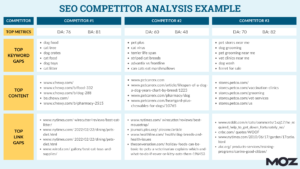
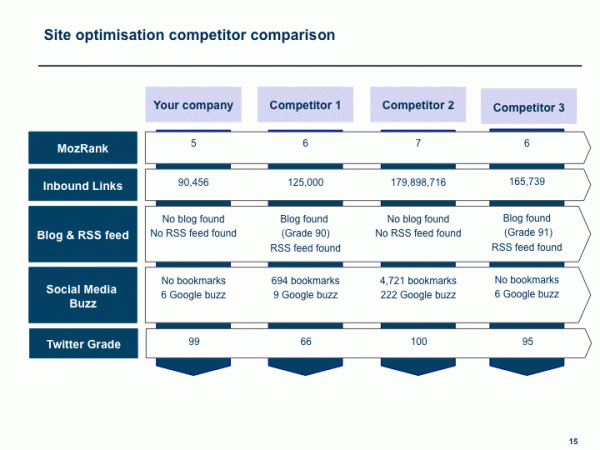
- Competitor matrix (columns: domain, DA/DR, organic traffic, #referring domains, top keywords, GBP status).
- Content gap spreadsheet (target keyword, search volume, current top pages, content angle).
- Link outreach tracker (prospect, contact, pitch sent, status).
- Link from high‑authority pages (blog pillars, resource hubs) to target service pages using keyword‑rich but natural anchor text.
- Create topical hubs (cluster pages) to show topical authority and distribute link equity.
- Anchor: “SEO Competitor Analysis” → Destination: competitor analysis service page.
- Anchor: “Local SEO Edinburgh” → Destination: Edinburgh local SEO landing page.
- Link to authoritative sources to support claims (e.g., Google’s SEO Starter Guide, Moz resources, Ahrefs blog posts).
- Suggested external references:
- Google Search Central: https://developers.google
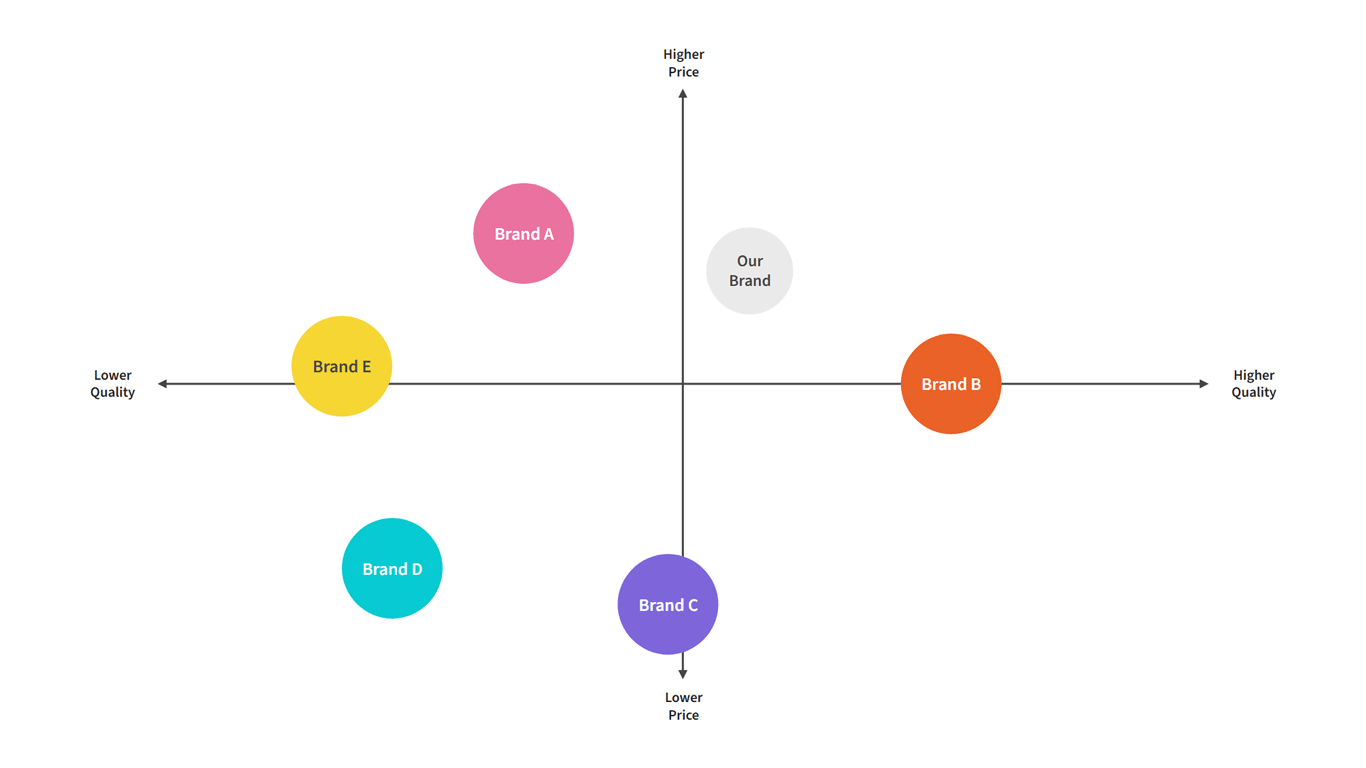
Step 1 — Define Your Competitors (Direct, Indirect, and SERP Competitors)
Competitor analysis starts with defining who you’re up against. Consider three types:
How to identify:
Deliverable: A prioritised competitor list (top 5–10 SERP competitors + 3–5 local competitors) with notes on business model, geography, and target keywords.
Step 2 — Crawl and Map Competitor Sites (Technical & Structural Audit)
Crawl each primary competitor’s site to understand structure, indexability, and technical strengths.
What to crawl:
Key technical elements to record:
Tools: Screaming Frog, Sitebulb, Ahrefs’ Site Audit, Google PageSpeed Insights, Lighthouse, GTmetrix.
Example insights to capture:
Actionable outputs:

Step 3 — On‑Page and Content Analysis
This focuses on what content competitors create, how it’s structured, and why it ranks.
Components to evaluate:
How to perform:
Examples of things to look for:
Actionable outputs:
Step 4 — Backlink Profile and Off‑Page Analysis
Backlinks remain one of the strongest ranking signals. Benchmark competitor authority and link strategies.
What to analyse:
Tools: Ahrefs, Majestic, Moz Link Explorer, SEMrush Backlink Audit, Google Search Console (for your own site).
Process:
Examples of insights:
Actionable outputs:
Step 5 — Local SEO and Google Business Profile (GBP) Audit
For location‑based businesses, local signals can be decisive. Benchmark how competitors perform in local search.
Local elements to review:
Tools: Google Maps, BrightLocal, Whitespark, Moz Local, Google’s GBP Insights.
Checklist:
Actionable outputs:
Step 6 — Technical & UX Competitor Benchmarks
SEO isn’t just about content — user experience and technical performance influence rankings and conversions.
Key UX/technical metrics to benchmark:
How to evaluate:
Actionable outputs:
Step 7 — Technical Keyword & SERP Feature Tracking
Track which SERP features competitors win for target keywords: featured snippets, People Also Ask, image packs, knowledge panels, local pack.
Why this matters:
How to proceed:
Actionable outputs:
Step 8 — Analyse Social Signals and Brand Presence
While social signals aren’t direct ranking factors, social distribution amplifies content reach, link earning, and brand searches.
What to evaluate:
Tools: BuzzSumo, Social Blade, native platform analytics, Google Trends.
Actionable outputs:
Step 9 — Pricing, Offers, and CRO Insights
Competitor pricing and offers influence click‑through rate and conversions. Understanding their commercial signals helps craft more compelling page content and offers.
What to investigate:
Actionable outputs:
Step 10 — Synthesize Findings into an Actionable SEO Strategy
With data collected, build a strategy that turns insights into action.
Structure your strategy:
Prioritisation framework:
Example strategic priorities for a small Edinburgh business:
Tools and Templates for Running Your Own Competitor Analysis
Essential toolset:
Suggested templates:
Internal and External Linking Recommendations
Internal links:
Internal anchor text suggestions:
External links: