
AI Search vs Google Search: What Businesses Need to Know to Prepare for the Future of SEO
Introduction
Search is changing. For two decades, Google Search defined how businesses reach customers online: keyword-optimised pages, backlinks, and technical SEO. Now, AI-powered search—where large language models (LLMs) and generative AI influence query understanding, results composition, and the user experience—is reshaping that landscape. For business owners and marketers, this isn’t a peripheral trend: it changes discovery, traffic patterns, conversion funnels, and how value is measured.
This article explains what AI Search is, how it differs from traditional Google Search, and what those differences mean for SEO and digital strategy. You’ll learn practical tactics—from content design and technical changes to measurement and local strategies—plus case examples and a step-by-step checklist to prepare your website for AI Search. Whether you work with an SEO Agency in Edinburgh or manage marketing in-house, this guide provides the up-to-date, actionable advice you need to future-proof search visibility and drive sustainable traffic and conversions.

What is AI Search? Defining the Term
AI Search refers to search systems that use artificial intelligence—particularly machine learning and large language models—to interpret queries, generate responses, and assemble multi-format results. Unlike traditional keyword-matching systems, AI Search can:
- Understand conversational, contextual, and multi-turn queries.
- Produce synthesized answers (text summaries, suggested next steps, or generated content snippets).
- Integrate knowledge from diverse sources, including proprietary datasets, knowledge bases, and third-party APIs.
- Present results as complete answers, not just ranked links.
- LLM-powered assistants that return synthesized answers in chat-like interfaces.
- Search engines that embed generative summaries above or instead of organic links.
- Vertical AI search solutions in e-commerce, finance, or healthcare that combine retrieval with generation.
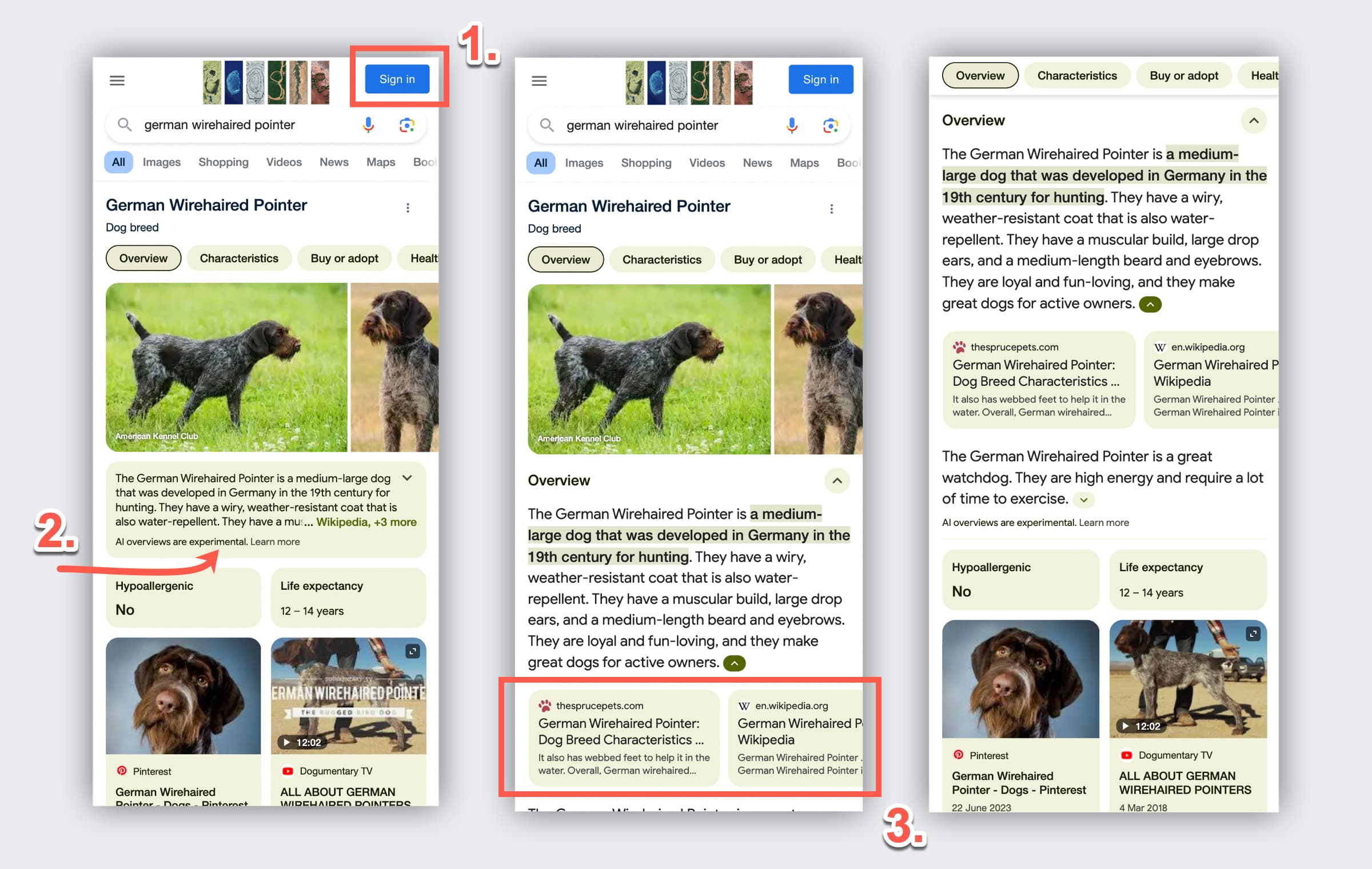
- Result format: Traditional SERPs emphasise ranked links, snippets, and structured features (featured snippets, People Also Ask, rich results). AI Search often delivers a conversational answer or consolidated summary that may remove the need to click through.
- Query handling: AI systems interpret intent holistically, making long-tail and conversational queries easier to satisfy without precise keyword phrasing.
- Source attribution: Generative answers may cite sources or not; transparency varies and is a current area of industry improvement.
- Personalisation and context retention: AI Search can maintain multi-turn conversation context, tailoring follow-up responses.
- Interaction model: Users may interact via chat, voice, or prompts, changing the search session dynamics.
- Opportunity for deeper integration: AI Search can connect to CRMs, inventories, or internal knowledge bases for personalised or transactional responses.
- Understanding: BERT and later transformer-based models improved query understanding.
- Ranking: MUM and other models enhance relevance and cross-lingual understanding.
- Generative features: Google has experimented with AI-generated summaries and “AI Overviews” in Search Labs and integrated Bard/assistant experiences.
- Structured outputs: Rich results, Knowledge Panels, and SERP features continue to coexist with AI outputs.
- New ranking signals: Content that is authoritative, up-to-date, and structured for direct answers is more likely to be surfaced in AI-generated responses.
- Shorter funnels: With answers delivered in-session, the path from query to decision shortens, demanding streamlined landing pages and frictionless conversion points.
- Misinformation risk: If AI models use outdated or incorrect sources, businesses must proactively supply trustworthy data and signals.
- Technical SEO matters: Fast pages, proper indexing, schema markup, canonicalisation, and crawlability are still foundational.
- User experience and E-A-T: Expertise, authoritativeness, and trustworthiness become even more important as AI systems prefer credible sources.
- Content structure and schema: Use structured data (Schema.org) to expose entities, product details, FAQs, how-tos, and event data in machine-readable formats.
- Content freshness and source signals: Keep core materials current; add publishing dates, update logs, and reference primary sources.
- Ownership of data: Build and expose site-level knowledge that AI systems can access (APIs, knowledge panels, structured feeds).
- Focus on SERP features and snippets: Optimize for featured snippets, knowledge panels, and other result types that AI overviews may draw from.
- Diversify traffic sources: Reduce dependence on organic clicks by investing in email, social, direct, referral, and paid channels.
- Use concise lead answers: Provide a one- to three-sentence summary at the top of pages (answer-first model) that an AI can extract.
- Structured sections and headings: Divide content into scannable, titled sections (H2/H3) around single intents.
- FAQ blocks: Add question-and-answer sections with natural-language questions that align with conversational queries.
- Provide data and citations: Include references, internal links, and citations to authoritative sources.
- Use JSON-LD and keep it accurate: Ensure markup mirrors visible content and is regularly validated.
- Expose product feeds and APIs: For e-commerce, provide updated product feeds and API endpoints that can be consumed by aggregator AI services.
- Maintain a knowledge base: Use a well-structured FAQ/KB that can be indexed and integrated with AI-driven assistants.
- Crawlability and indexability: Ensure robots.txt, sitemaps, and canonical tags are correct; avoid content hidden behind login where public answers are needed.
- Language and locale signals: Use hreflang and clear locale markers; AI systems can draw on cross-lingual content but need correct metadata.
- API and data endpoints: Where possible, provide machine-readable APIs or data feeds for product availability, inventory, or events.
- Use PR and owned channels: Leverage press, newsletters, and social channels to shape authoritative narratives that AI systems may use as source signals.
- Syndication strategy: Carefully syndicate content to authoritative platforms with canonical links back to your site.
- Measure downstream conversions: Monitor assisted conversions, brand query uplift, and conversion rate changes, not just organic sessions.
- Log and monitor source citation: Monitor where your brand or pages are referenced in AI answers (search result snapshots, manual checks) and use that to inform content updates.
- Use product feeds and guarantee freshness: Keep inventory, pricing, and shipping data current via APIs or merchant feeds.
- Optimise for purchase intent: Create short, answerable descriptions and comparison pages that help AI make recommendations.
- Local schema and FAQs: Add LocalBusiness schema, opening hours, service areas, and structured FAQs for common local queries.
- Reviews and reputation: Encourage reviews on primary platforms—AI systems often use review signals for trust.
- Authoritative resources: Publish whitepapers, case studies, and data that signal expertise.
- Integrate support knowledge: Make documentation and knowledge bases public and well-structured so AI assistants can surface accurate support responses.
- Author and publication signals: Prominent author bios and editorial standards improve E-A-T; AI models favour trustworthy outlets for factual responses.
- Attribution models must adapt to account for impressions, brand lifts, and downstream conversions.
- Maintain diversified traffic and control over owned channels.
- Implement basic structured data: FAQPage, Article, Product, LocalBusiness as applicable.
- Add concise lead answers to key pages: 1–3 sentences that directly answer common queries.
- Ensure technical health: Fix crawl errors, improve mobile responsiveness, and optimise core web vitals.
- Claim and standardise business listings: Google Business Profile, Bing Places, Apple Maps.
- Build and publish a public knowledge base: FAQs, how-tos, troubleshooting guides in a consistent structure.
- Implement product feeds/APIs: For e-commerce, ensure merchant feeds are accurate and live.
- Start monitoring AI citations: Use manual checks, SERP APIs, and third-party tools to spot references to your brand.
- Integrate schema across site: Deepen markup—pricing, availability, review snippets, event schema where relevant.
- Develop server-side APIs for data: Allow trusted partners or crawlers to access fresh, authoritative data.
- Update measurement: Reconfigure analytics and attribution models for AI-era conversions; track assisted conversions and brand lift.
- Reputation management: Monitor mentions and correct misinformation promptly.
- Experiment with AI features: Develop chat experiences, API integrations, or conversational assistants to capture demand directly.
- Content strategy: Topic clustering, answer-first content, and knowledge-base design.
- Measurement guidance: New KPIs, attribution models, and visibility tracking.
- Integration services: Feed and API setup, knowledge graph management, and partnership with engineering teams.
- How will you measure visibility when clicks decline?
- Can you implement and validate structured data and knowledge feeds?
- Do you have case studies showing improved conversions under AI-driven SERP changes?
- Supporting bullets: 3–5 bullets of key facts (price, lead time, core benefits).
- CTA: Single clear CTA (Call, Book, Buy) with schema markup.
- A: Short answer (1–2 sentences), then “How it works” bullets and a link to “Learn more” canonical page.
- Impression and visibility metrics: Monitor where possible in Search Console and third-party tools.
- Assisted and micro-conversion tracking: Newsletter signups, content downloads, CTA clicks from SERP.
- Conversion rate by channel: Look at whether fewer visits deliver more qualified traffic.
- Brand search volume and share of voice: Track increases in branded queries and mentions.
- Downstream value: Customer acquisition cost (CAC), lifetime value (LTV), and revenue attribution for AI-sourced leads.
- Copyright and content ownership: If AI summarises your content, understand reuse terms and pursue proper attribution when necessary.
- Transparency in AI-driven responses: Where you deploy AI assistants, label generated content and provide sources to maintain trust.
- Organic clicks decline slightly for simple queries; complex queries still drive clicks.
- Action: Focus on structured content and conversion optimisation.
- Click-through declines accelerate; direct integrations with merchants and service providers grow.
- Action: Provide machine-readable APIs and transactional integration; prioritise owned channels and user-centred conversion flows.
- Brand reputation and data partnerships matter more than raw SEO signals.
- Action: Build long-term authority via partnerships, data feeds, and cross-channel presence.
Examples of AI Search include:

How AI Search Differs from Traditional Google Search
Key technical and user-experience differences:
Where Google Search Stands Today: AI + Traditional Ranking
Google is not static. Over recent years, it has integrated AI at multiple layers:
For businesses, Google currently blends retrieval-based ranking with AI-enhanced understanding and result presentation. That means many SEO best practices remain relevant, but tactics must adapt to new result types and user behaviours.
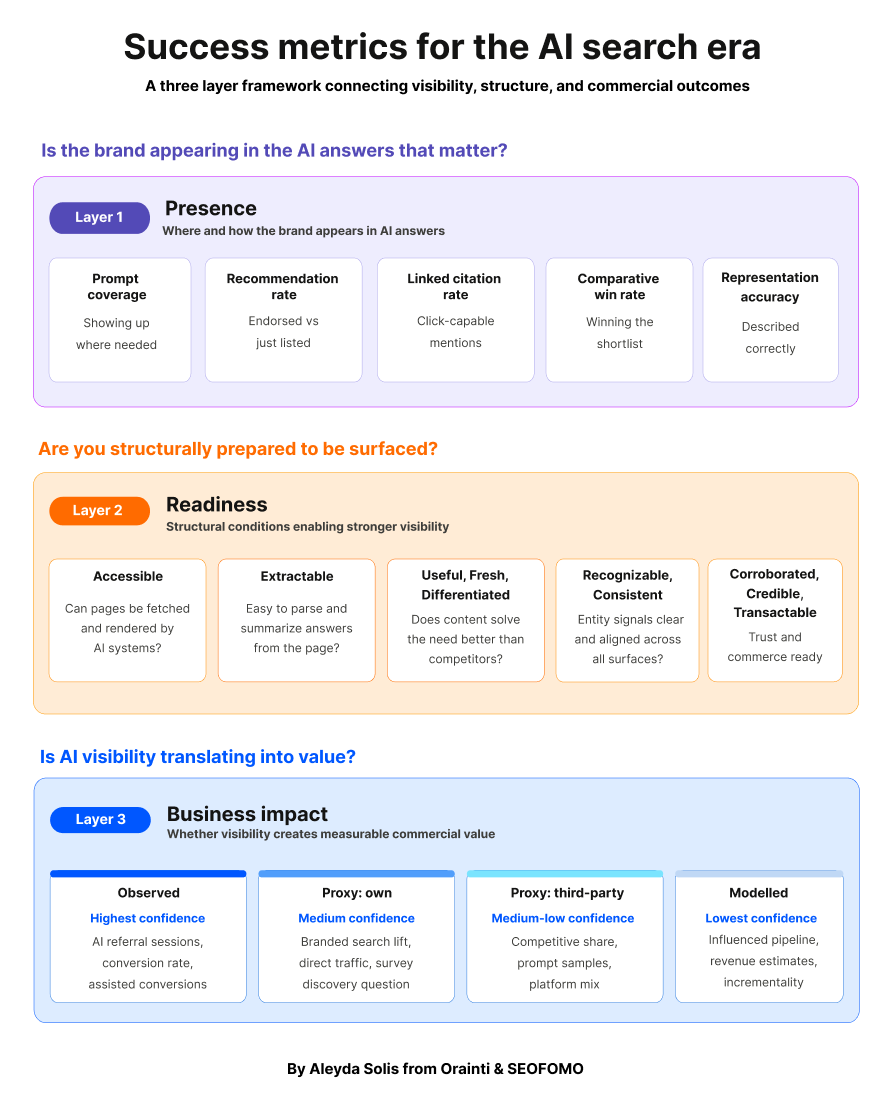
Why AI Search Matters to Businesses
AI Search impacts businesses across three main dimensions:
1. Traffic and Visibility
– Decline in organic clicks: When search provides full answers, users may not click through, reducing organic traffic even if brand visibility remains high.
2. Conversion and User Experience
– Higher intent capture: AI can guide users to relevant products or information faster, improving conversion if integrated with commerce flows.
3. Brand Reputation and Control
– Attribution challenges: Generative answers could reference or summarise your content without sending visitors; ensuring accurate attribution and preventing misrepresentation becomes critical.
Implications for SEO: What Changes and What Stays the Same
Many core SEO principles endure, but tactics and priorities shift.
What Stays the Same
– High-quality, relevant content remains essential. AI models still rely on underlying content to generate accurate responses.
What Changes (and How to Adapt)
– Answer-first content: Create content designed to be directly consumable by AI systems—concise summaries, clear facts, and structured data that an AI can use as evidence.
AI SEO: A Practical Framework for Optimisation
AI SEO integrates traditional SEO with strategies tailored to AI-driven discovery. Below is a practical framework businesses can apply.
1. Content Design for AI Consumption
– Start with a clear objective per page: answer a question, solve a problem, or facilitate a transaction.
2. Structured Data and Knowledge Management
– Implement relevant Schema.org types: Article, FAQPage, HowTo, Product, Review, LocalBusiness, Person, and Organisation.
3. Technical SEO for AI Search
– Speed and Core Web Vitals: Prioritise fast load times; AI-driven assistants may penalise slow or poorly performing pages by not sourcing them.
4. Content Distribution and Amplification
– Build authoritative inbound signals: Earn links from reputable sites, citations in industry publications, and consistent brand mentions.
5. Measurement and Analytics for AI-Driven Discovery
– Reconcile visibility vs clicks: Track impressions or mentions where possible (Google Search Console, third-party SERP trackers) to measure visibility even if clicks decline.
Specific Tactics for Businesses by Use Case
Different business models should take different approaches. Below are tailored tactics.
E-commerce and Retail
– Provide detailed product schema: Price, availability, SKU, GTIN, brand, and rich product descriptions.
Local Businesses and Services
– Claim and optimise business listings: Google Business Profile, Bing Places, Apple Maps—ensure NAP consistency.
B2B and SaaS
– Create problem-solution pages: Use clear “what,” “why,” and “how” sections to help AI generate useful overviews.
News and Media
– Speed and verification: Publish accurate, clearly sourced updates; use structured data for articles and press releases.
Case Studies and Early Examples
Real-world observations illustrate the change.
Case: E-commerce Brand Reduced Bounce but Saw Fewer Organic Sessions
An online retailer optimised product pages with answer-first content and structured schema. Over six months, organic sessions dropped slightly as AI summaries increased, but conversion rate rose 18% because users arriving from new AI-driven pathways were more qualified. The retailer expanded its email capture on product snippets to offset reduced clicks.
Case: Local Service Provider Improved Visibility in AI Overviews
A local plumbing company added detailed LocalBusiness schema, FAQs, and service-specific pages. AI assistants began referencing the company in local answer boxes; phone calls increased 24% as users found direct contact details within result snippets.
Case: SaaS Company Leveraged Knowledge Base for AI-Driven Support
A SaaS provider made its support knowledge base publicly accessible with structured FAQs and canonical docs. AI chat assistants started returning the company’s documentation as the primary source for troubleshooting answers, reducing support tickets and improving product adoption.
Risks and Challenges with AI Search
AI Search presents opportunities but also real risks.
Attribution and Revenue Measurement
– Fewer clicks may complicate ROI calculations for organic SEO.
Content Misrepresentation
– Generative summaries may misstate facts or omit context; brands need to be proactive about accurate data and rapid corrections.
Over-Reliance on Third-Party AI Platforms
– If your discovery depends on one AI provider, platform policy changes can impact visibility.
Privacy and Data Concerns
– AI integrations that use customer data must comply with GDPR, CCPA, and other privacy frameworks.
Practical Roadmap: Prepare Your Website for AI Search (Step-by-Step)
This actionable checklist helps prioritise tasks. Start with the foundational items, then progress to advanced integrations.
Phase 1 — Foundation (0–3 Months)
– Audit existing content: Identify high-value pages, FAQ gaps, and pages with strong intent but low conversion.
Phase 2 — Growth (3–6 Months)
– Expand answer-first content: Convert long-form pages into modular sections with clear headings and summary boxes.
Phase 3 — Maturity (6–12 Months)
– Create a content hub: Cluster topic pages with pillar content and supporting FAQs to strengthen topical authority.
Phase 4 — Ongoing Optimisation
– Regular content refresh cycles: Review cornerstone pages quarterly and update facts and citations.
How to Work with an SEO Agency (Including SEO Agency Edinburgh)
Many businesses benefit from partners who specialise in both traditional SEO and AI optimisation.
What to Expect from an AI-Savvy SEO Agency
– Technical implementation: Schema, structured data, sitemaps, and crawl optimisation.
Questions to Ask Potential Agencies
– What experience do you have with AI-driven search optimisation?
If you’re searching locally, an SEO Agency Edinburgh should demonstrate both local SEO expertise and experience with structured data and AI content strategies—particularly valuable for businesses targeting Scottish or UK markets.
Content Examples and Templates
Use these practical templates for quick implementation.
Short Answer Box (for Service/Product Pages)
– Lead answer (1–3 sentences): Clear, concise summary of the page’s primary question.
FAQ Structure (JSON-LD Eligible)
– Q: What is [service]?
Product Data (Recommended Fields)
– Name, SKU, GTIN, brand, price, currency, availability, shipping info, short description, image URL, reviews average rating, number of reviews.
Measurement: KPIs for AI Search Success
Move beyond sessions and organic clicks. Focus on:
Legal, Ethical, and Privacy Considerations
– Data privacy: When integrating with AI platforms, ensure consent for personal data; update privacy policies.
Future of SEO: Realistic Scenarios and Timelines
AI Search will continue evolving; here are plausible scenarios and practical implications.
Scenario 1: Incremental Integration (Near-Term, 1–2 Years)
– AI features integrated into existing search interfaces (more overviews and succinct answers).
Scenario 2: Conversational Dominance (Medium-Term, 2–5 Years)
– Conversational assistants become common entry points; users rely on chat-first search for many queries.
Scenario 3: Distributed Discovery (Long-Term, 5+ Years)
– Search becomes embedded in apps and devices (voice assistants, in-product discovery), and AI mediates more decisions.
FAQs (Optimised for Voice and Featured Snippets)
Q: Will SEO become obsolete with AI Search?
A: No. The goals of SEO—discoverability, relevance, and user experience—remain essential. Tactics will evolve to emphasise structured content, authoritative data, and integrated conversions.
Q: Will I lose traffic if AI Search provides answers directly?
A: Possibly. Some query types will result in fewer clicks. The priority is to convert the traffic you keep, capture leads within snippets, and diversify channels.
Q: How important is structured data for AI Search?
A: Very important. Structured data helps AI systems accurately identify entities, attributes, and authoritative answers, improving the likelihood your content will be used.
Q: Should I work with an SEO Agency in Edinburgh or a specialist AI SEO provider?
A: Choose an agency with demonstrable experience in both technical SEO and AI-aligned content strategy. Local agencies are valuable for location-specific businesses; specialist AI SEO partners help for advanced integrations.
Internal and External Linking Recommendations
Internal Linking
– Anchor text: Use natural, descriptive anchors that reflect user intent (e.g., “emerg